Investor Overview • Validation-Driven Aerospace Development

Investing in disciplined propulsion validation.

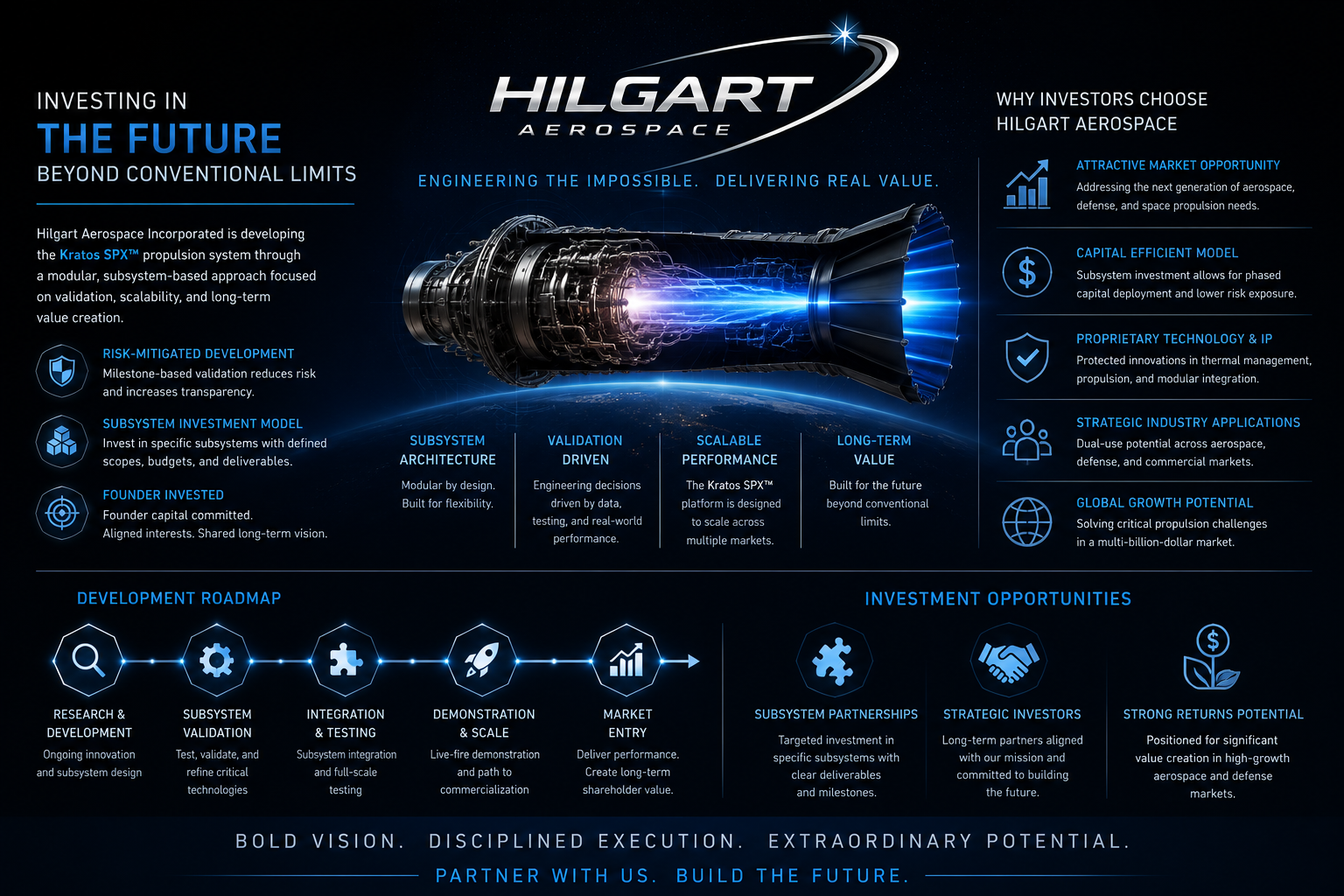
Hilgart Aerospace Incorporated is developing Kratos SPX as a modular propulsion architecture built around Thermal-Power Equilibrium™, subsystem-first validation, and milestone-based capital deployment.

The near-term investment strategy is focused: validate the thermal foundation, define subsystem interfaces, reduce technical uncertainty, and advance toward measurable engineering evidence before full platform integration.

SAFE Investment Structure Thermal Validation Subsystem-First Risk Reduction Focus
Hilgart Aerospace investor page graphic Click to enlarge
Current FocusThermal validation
PlatformKratos SPX
MethodSubsystem-first
ObjectiveRisk reduction
Investment Thesis

Fund specific validation milestones, not broad unsupported claims.

Hilgart Aerospace is developing the Kratos SPX as a modular propulsion platform. The investor strategy is focused on funding defined subsystem work packages through design review, modeling, trade studies, technical validation planning, and independent review rather than attempting to finance full system development in a single step.

This approach allows capital to be tied to measurable engineering outputs, reduces scope ambiguity, and helps technical partners evaluate specific risk areas before full integration.

Defined Deliverables Milestone Capital Validation Framework™ Thermal-Power Equilibrium™

Why Thermal Validation Comes First

Higher-energy propulsion systems are constrained by heat generation, thermal distribution, coolant transport, material limits, and heat rejection. The first validation target is proving that the thermal foundation can support later propulsion development.

Why Subsystems Matter

SPX is structured around removable, replaceable, testable, and independently reviewed subsystems. This improves serviceability, isolates failure modes, and allows design changes based on validation data.

Risk Reduction Strategy

The company is being built around disciplined technical progression.

Investor credibility improves when the development path is specific. Hilgart Aerospace is organizing early execution around thermal validation, subsystem definition, independent review, and staged integration.

01. Thermal Foundation

Validate heat generation, heat distribution, coolant transport, material limits, radiator requirements, and thermal extraction assumptions.

02. Subsystem Interfaces

Define mechanical, thermal, electrical, sensor, control, service, and safety boundaries before full integration.

03. Independent Review

Use technical advisors, universities, laboratories, and outside reviewers to challenge assumptions and strengthen credibility.

04. Integration With Data

Move toward full SPX integration only after subsystem behavior is understood through modeling, review, and validation planning.

SAFE Investment Approach

Early participation may be structured through attorney-reviewed SAFE agreements.

Hilgart Aerospace may use a Simple Agreement for Future Equity, commonly known as a SAFE, for early-stage investment participation. A SAFE allows qualified investors to provide capital now, with the investment converting into equity during a future priced financing round according to the agreed terms.

Future Equity Conversion Founder Control Preserved Milestone Updates Attorney-Reviewed Documents

What SAFE Investors Receive

  • A signed investment agreement documenting amount and conversion framework
  • Future equity conversion rights under agreed SAFE terms
  • Periodic company and milestone updates
  • Participation in early validation-stage growth

What SAFE Investors Do Not Receive Automatically

  • No automatic board seat
  • No officer role or management authority
  • No operational control of engineering decisions
  • No guarantee of return, liquidity, or future financing

Important Investor Notice

Any investment in Hilgart Aerospace involves significant risk, including the possible loss of the entire investment. This page is an informational overview and is not a formal securities offering, prospectus, or investment recommendation. Prospective investors should review all offering documents, risk disclosures, and legal materials before making any investment decision.

Capital Deployment

Capital is intended to convert into engineering evidence.

Based on current planning, each major SPX subsystem may require approximately $300,000 to $1,000,000 to move from design review through engineering refinement, prototype planning, technical validation, and independent review. Actual costs may vary by material selection, test requirements, laboratory engagement, fabrication complexity, and validation scope.

Thermal Management System

$300K–$1M

Thermal-power balance modeling, coolant trade study, materials review, radiator sizing, thermal spine analysis, and validation planning.

Thermal / Electric Auxiliary Power

$300K–$1M

Waste heat recovery analysis, Brayton-cycle integration studies, power routing, efficiency modeling, and subsystem interface definition.

Multi-Gas Combustion / Plasma

$300K–$1M

Gas-ring design review, mixture control, flow balance, pressure stability, material exposure, and combustion-plasma validation planning.

Magnetic Velocity & Flow Stabilization

$300K–$1M

Magnetic field architecture, propellant-flow stabilization, interface controls, thermal exposure effects, and performance modeling.

Plume / Exhaust Control System

$300K–$1M

Plume shaping, vector-control concepts, thermal and structural loading, exhaust stability, and subsystem validation requirements.

HUMAN™ AI Control System

$300K–$1M

Sensor integration, diagnostics, fault response, autonomous decision support, subsystem coordination, and control-logic validation.

Milestone Roadmap

Milestone-based capital deployment.

Subsystem investment is intended to be released and managed around defined milestones. The objective is to convert capital into engineering outputs, not general overhead.

MilestonePrimary WorkExpected Deliverable
Milestone 1Engineering review and assumption validationTechnical review package and risk notes
Milestone 2Modeling, trade studies, and subsystem interface reviewThermal-power model, coolant trade study, and interface recommendations
Milestone 3Detailed design refinement and manufacturing package preparationUpdated drawings, material selections, fabrication planning, and test plan
Milestone 4Prototype / test article planning and independent reviewValidation roadmap, independent review report, and next-stage funding plan

Hardware fabrication and full test execution may require additional capital depending on subsystem complexity and laboratory requirements.

Request the investor presentation.

Hilgart Aerospace is refining investor materials around subsystem investment, thermal management validation, SAFE participation, and milestone-based capital deployment. Qualified investors and strategic partners may request the current investor presentation for review.